

Maritime
Maritime and Avoided Emissions
Shipping and the Climate Transition
Maritime transport carries the majority of global trade and is one of the largest contributors to CO₂ emissions worldwide. Sustainable marine fuels (SMF, also referred to as SAF for shipping) are now the primary lever for reducing these emissions. By replacing heavy fuel oil or marine diesel with sustainable alternatives, shipping companies can demonstrate significant avoided CO₂.
We provide calculations and certifications tailored to the way the industry operates. Results can be presented at different levels of detail: per container, per voyage, per vessel, per fleet, or aggregated annually. This flexibility means companies can use the data for client-facing or institutional reporting, operational performance tracking, or regulatory compliance.
Sustainable Marine Fuels
-
Per Container
Every container moved on a vessel can be assigned its share of avoided CO₂, allowing logistics companies to send tailored sustainability reports directly to their clients. -
Per Voyage
Avoided emissions can be reported for individual trips, showing how fuel blends affect the climate footprint of a specific shipping route. -
Per Vessel
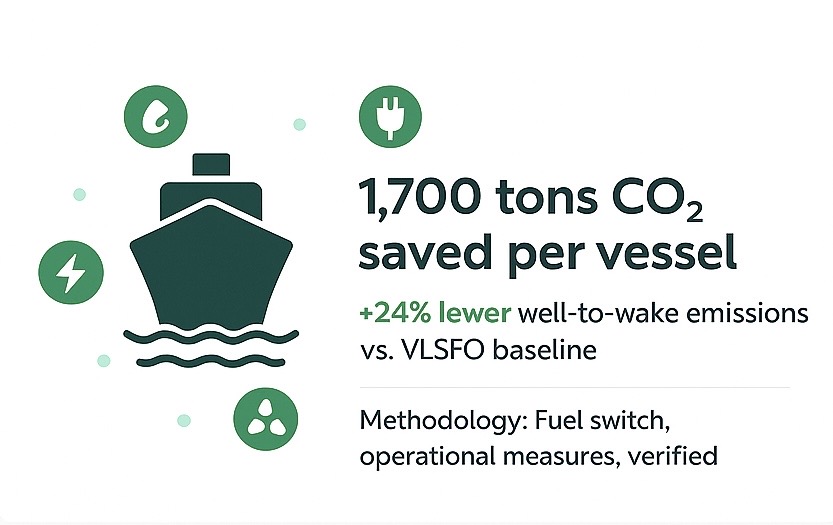
Each ship can have its avoided CO₂ certified, enabling operators to track efficiency gains across their fleets. -
Per Fleet
Shipping companies can quantify the cumulative avoided emissions across their entire fleet, a critical tool for corporate ESG disclosures and investor reporting. -
Aggregated Annually
Annual reporting captures the total contribution of sustainable fuels to decarbonization, aligning with regulatory frameworks such as the EU ETS for shipping and IMO requirements.

Reporting and Outputs

Avoided emissions in maritime transport must be presented in a way that is not only accurate but also usable by different stakeholders. To achieve this, results are delivered in multiple formats, ensuring relevance for both internal teams and external partners:
- Client documentation
For companies transporting containers, we provide per-container or per-voyage avoided CO₂ reports. These documents can be shared directly with cargo owners, offering them proof that their shipments were moved using sustainable fuels. This creates an additional layer of transparency in the logistics chain and strengthens commercial relationships. - Digital dashboards
Vessel- and fleet-level results are made available through dedicated software platforms. These dashboards allow sustainability, compliance, and operations teams to track avoided emissions in real time, monitor progress toward decarbonization goals, and prepare data for ESG reporting. Dashboards can be customized to show results per container, per voyage, or aggregated across the entire fleet.
Why It Matters for Automotive Companies
Avoided emissions in the automotive sector are not just about technology they are proof of your company’s direction and discipline.
Formal reporting is delivered in alignment with leading international standards, including DEFRA, EEA, IPCC, EU Commission methodologies, GHG Protocol, EcoInvent, and Bilan Carbone. These certified documents are suitable for integration into annual sustainability reports, CSRD disclosures, and submissions to regulators such as the IMO and the European Commission.
Each year, companies receive official certification summarizing avoided emissions from sustainable marine fuels across their operations. These certificates can be presented to investors, clients, and regulators as a verified confirmation of decarbonization progress at the corporate level. Certificates can also be broken down by vessel or by trade lane if required.
Technical numbers are transformed into clear visual equivalents — such as tons of fuel saved, cars removed from the road, or trees planted. These summaries make avoided emissions accessible to non-technical audiences, allowing shipping companies to communicate results in client presentations, marketing materials, or public disclosures without losing credibility.